Skip to content
Bruno Ferreira

Backend Systems · Marketplace

Neon Arsenal Market

A backend-first marketplace built around the failure modes CRUD demos avoid: concurrent inventory, idempotent orders, payment reconciliation, financial compensation, and operational evidence.

TypeScript · Node.js · Express · PostgreSQL · Prisma · Docker · k6

Role
Backend architecture & implementation
Year
2026
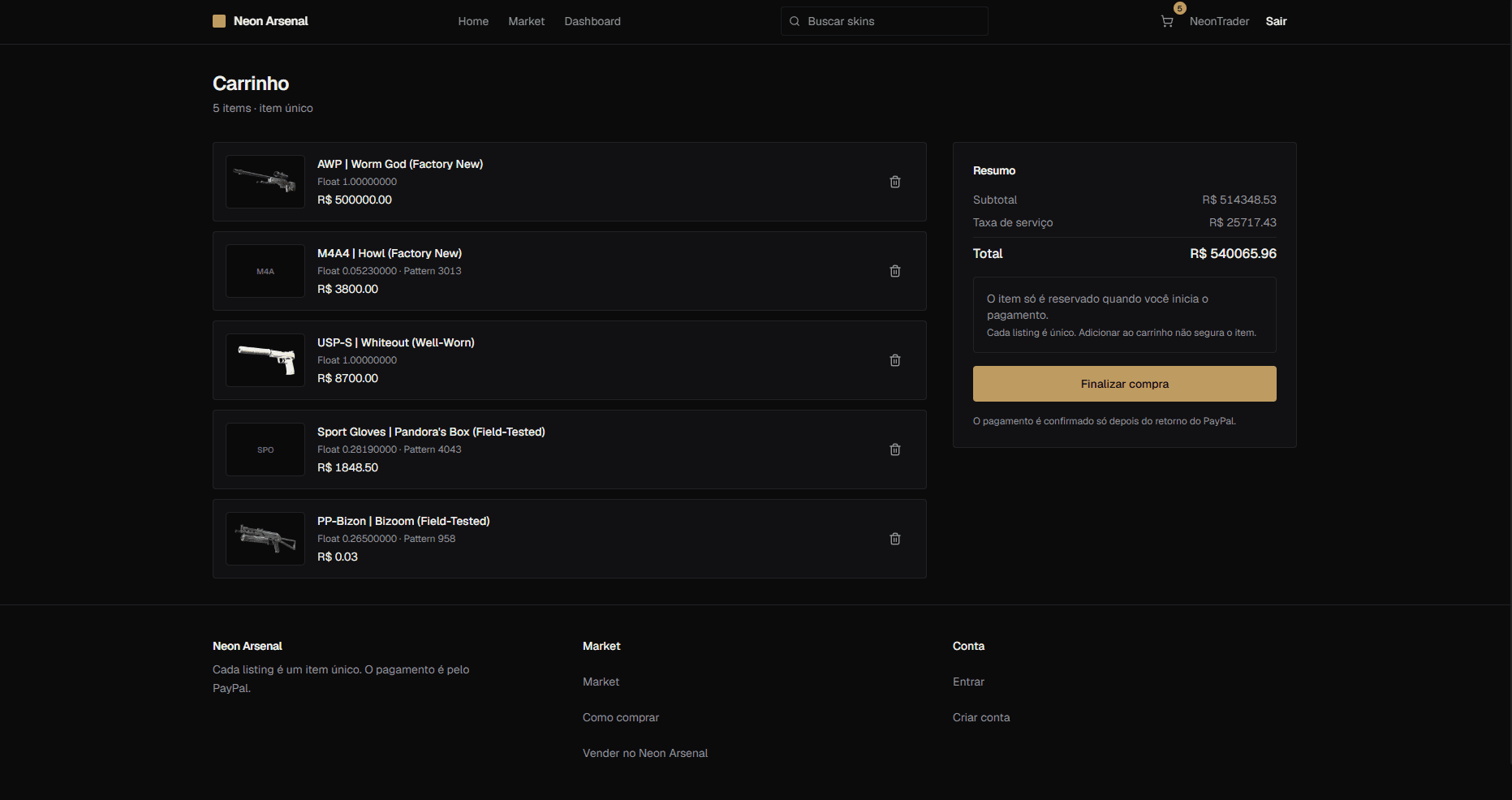
Neon Arsenal checkout with five unique CS2 items in the cart and a payment summary before PayPal capture.

Neon Arsenal is my main backend engineering case study. The product is a marketplace for unique Counter-Strike 2 items, but the real subject is correctness: what happens when two buyers race for one listing, a payment provider succeeds while local state fails, a webhook is duplicated, or a process crashes halfway through a workflow.

At a glance

The case in under a minute.

Portfolio Complete · Maintenance Mode
System
Marketplace for unique inventory
Core challenge
Prevent double-selling while payment state remains recoverable
Architecture
Modular monolith · PostgreSQL source of truth
Engineering focus
Concurrency · Idempotency · Payments · Recovery · Operability

The functional roadmap is closed. The project is intentionally frozen as a portfolio case study; future architecture work requires a measured problem and a new engineering decision, not a larger technology stack.

Architecture

Current system, without decorative infrastructure.

The current deployment is intentionally small: browser traffic reaches a Vite SPA, the SPA calls one Express API, and PostgreSQL owns business truth. External providers remain outside that trust boundary.

Client

Browser

Vercel

Vite SPA

Static frontend. Not a security boundary.

Render

Express API

AuthOrdersListingsPaymentsLedgerReconcileOutboxJobs

Source of truth

PostgreSQL

Orders, listings, payments, ledger, idempotency, webhook and outbox state.

External boundaries

PayPal · Resend · cs2.sh

Untrusted integrations around the authoritative database state.

Redis, Kafka, SQS, a separate worker service, ECS/Fargate, RDS, and an ALB are not presented as live architecture because they are not part of the current canonical deployment.

What the design guarantees

Engineering outcomes, not feature claims.

01

Two concurrent buyers cannot both acquire the same unique listing.

02

Replaying the same valid order request does not create a second order.

03

Duplicate verified PayPal webhook delivery converges to a no-op after the event is persisted.

04

A lost payment webhook can be recovered through reconciliation against PayPal.

05

Captured money that cannot be fulfilled becomes an explicit refund obligation instead of hidden state drift.

06

Background side effects are coordinated through durable PostgreSQL records before a broker is justified.

Critical flows

Where correctness is won or lost.

01 · Concurrency

Two buyers. One listing. One winner.

Buyer A

POST /orders

Buyer B

same listing

PostgreSQL conditional transition

ACTIVE → RESERVED

Winner

201 · order committed

Loser

409 · reservation conflict

The invariant lives in PostgreSQL, so correctness does not depend on which API process receives the request.

02 · Partial failure

Money moved. Fulfillment did not.

PayPal capture COMPLETED

Local fulfillment path fails

Persist, do not hide

Durable refund obligation

Reconciliation / compensation

Payment truth is recoverable even when delivery is duplicated, delayed, lost, or interrupted halfway through a workflow.

03 · Durable side effects

Durable side effects without pretending there is a queue

  1. 01Business state and OutboxEvent are committed in PostgreSQL.
  2. 02An in-process job claims outbox rows using database coordination.
  3. 03Publication is retriable and idempotent against durable records.
  4. 04A separate broker is deferred until measured backlog, ordering, replay, or throughput needs justify one.

The design keeps failure recovery explicit without adding distributed infrastructure solely for appearance.

Key engineering decisions

The important part is what was deliberately not added.

PostgreSQL owns the invariant

Decision

Keep unique-inventory correctness in conditional database state transitions.

Why

Process memory cannot safely coordinate competing buyers once more than one request or API replica is involved.

Modular monolith before microservices

Decision

Keep one deployable API while domain boundaries remain explicit inside the codebase.

Why

The current product does not justify the operational cost of distributed ownership, networking, deployment, and recovery.

Reconciliation over webhook trust

Decision

Treat webhooks as an unreliable signal, not the only path to payment truth.

Why

Delivery can be duplicated, delayed, or lost, so recovery must converge through persisted state and provider reconciliation.

Durable outbox before a broker

Decision

Commit business state and outbox records together, then publish from an idempotent in-process job.

Why

A queue should arrive when measured backlog, replay, ordering, throughput, or independent-consumer requirements make it necessary.

Scaling path

Scale from measured pressure, not from a technology checklist.

Today

One modular-monolith API, one PostgreSQL source of truth, and idempotent in-process jobs.

Triggers

Database saturation, connection pressure, shared rate-limit needs, sustained job lag, or an outbox backlog that requires independent scaling.

Possible next steps

Redis for demonstrated shared coordination, a separate worker for independent background throughput, and a broker only when replay, ordering, throughput, or multi-consumer requirements justify it.

What was deliberately left unfinished

Known limits are frozen, not disguised.

The final audit separates credible future improvements from portfolio theater. These limits remain visible because closing them would require a real product, operational, or scale requirement.

Confirmed-order cancellation policy

The customer cancellation/refund semantics for already-confirmed orders remain an explicit product decision rather than a hidden implementation gap.

Deeper payment-link and capture recovery

Two legitimate recovery-depth improvements remain frozen because they do not create a duplicate economic effect in the current system.

Standalone reservation abuse hardening

Authenticated standalone reserve can still create TTL-bounded inventory griefing; closing it requires an explicit product/API decision.

Production evidence boundaries

Production OTLP reception, managed backup/restore, sustained production SLOs, HA, and multi-region capacity are not claimed because they were not proven.

Implementation notes

How the design is enforced in code and operations.

Correctness under concurrency

Unique listings are reserved through PostgreSQL transactions and conditional state transitions so concurrent buyers cannot both acquire the same item. Order creation is customer-scoped and idempotent, with the key, canonical request hash, order, and reservation effects converging in the database.

Failure-aware money flows

PayPal is treated as an unreliable external boundary. Capture, webhook processing, reconciliation, and compensation are designed around retries and partial failure. When money is captured but fulfillment can no longer complete, the system creates a durable refund obligation; seller financial history remains append-only through compensating entries.

Operational design

The API exposes health and readiness probes, structured logs, request IDs, optional OpenTelemetry, runbooks, explicit shutdown behavior, reconciliation jobs, and database-backed invariants. Operational behavior is documented alongside application behavior rather than treated as deployment trivia.

Performance evidence, not marketing

The repository separates query-plan evidence from load-test evidence. PostgreSQL hot paths are measured with EXPLAIN ANALYZE and service timing, while k6 capacity runs use isolated disposable environments and record offered load, achieved RPS, latency, failures, dropped iterations, resource usage, and domain invariants. Controlled CI results are explicitly not presented as Render or production capacity.

Reviewer proof

Start with the high-signal artifacts.

The project has a dedicated review path, a canonical case study, a claim-to-proof index, an adversarial Senior Backend audit, and a bounded operational-proof phase.

Final audit scope: 28 dimensions, 34 findings, seven P0 findings corrected and re-verified, unresolved P0 = 0. Remaining P1 limitations are documented and frozen rather than presented as completed work.

Engineering evidence

Inspect the implementation details.

The reviewer path above is the fast route; these repository artifacts expose the deeper architecture, reliability, operations, and performance proof.

This project is intentionally frozen. Further architecture work requires a measured problem, not a larger technology stack.

The live product shows the customer experience. The repository and architecture links show the engineering decisions, failure handling, and evidence behind it.

Next: Team Scrapbook